

Internal Tree Inspection
At Beyond the Bark Ltd, we specialise in assessing the internal condition of trees using Visual Tree Assessment (VTA), the PiCUS 3 Sonic Tomograph, the PiCUS TreeTronic 3 Electrical Resistance Tomograph and PD400 Microdrill. Our cutting-edge tools and expert analysis provide precise, data-driven insights to guide safe and sustainable tree management.
Beyond the Bark pride themselves on being at the forefront of innovation and technology
Our internal inspection techniques utilise state-of-the-art technology, including the PICUS3 Sonic Tomograph, the PiUCS TreeTronic 3 Electrical Resistance Tomograph and the IML Resi-PD400 Microdrill, ensuring precise and accurate assessments of a tree's structural integrity.
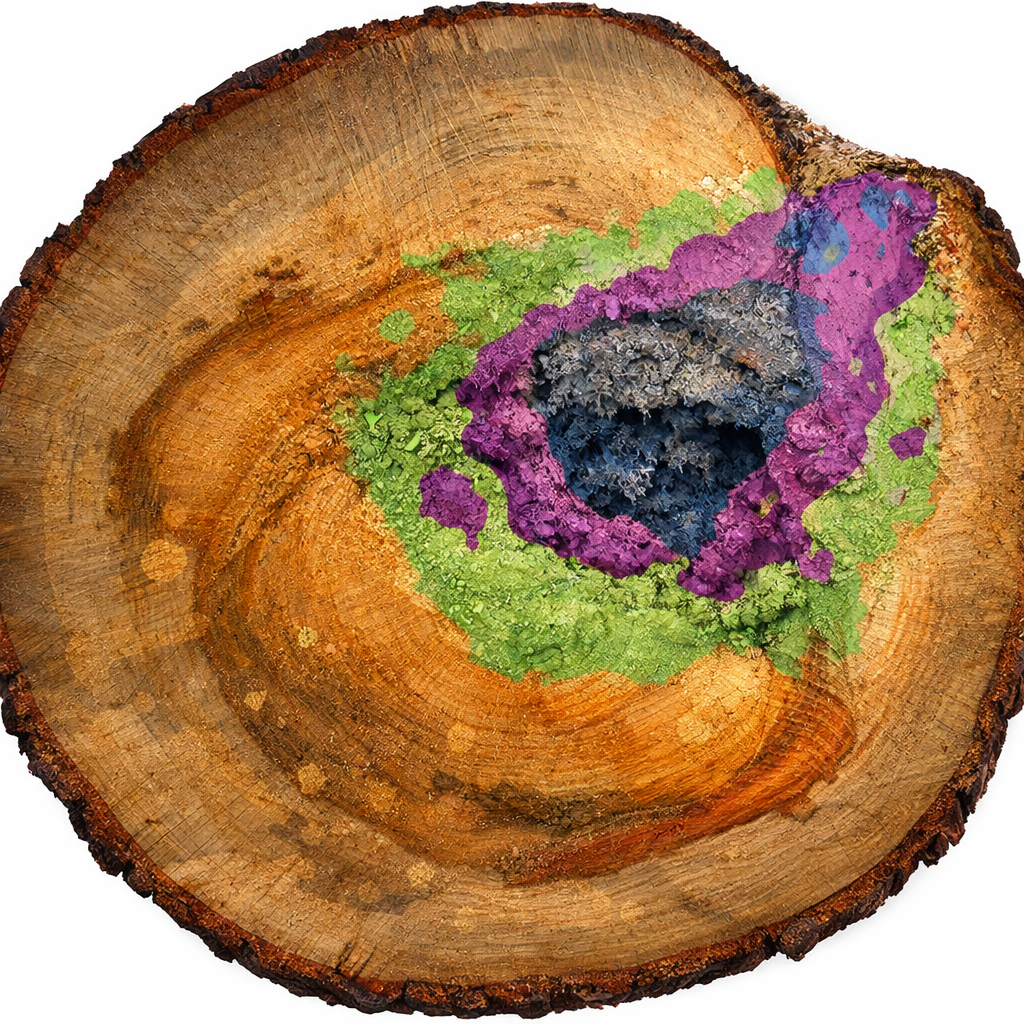
Sonic and Electrical Resistance Tomography
Visual Tree Assessment (VTA): Interpreting External Indicators of Structural Condition
Visual Tree Assessment (VTA), developed by Dr Claus Mattheck, provides a structured method for interpreting external features of a tree in relation to its mechanical stability and adaptive growth. Observations of form, buttressing, cracking, cavities and other structural indicators are used to identify how a tree has responded to loading over time and whether further investigation of the internal condition of the stem is required. Where appropriate, findings from VTA inform the targeted use of sonic tomography and other diagnostic tools to support proportionate, evidence-based management decisions.
PiCUS 3 Sonic Tomography: Assessing the Internal Condition of Trees
The PiCUS 3 Sonic Tomograph assesses the internal condition of a tree by measuring how sound waves travel through the stem. Sound moves more quickly through intact structural wood and more slowly through areas of altered or decayed timber. Sensors positioned around the trunk record these differences in transmission speed and the data are used to produce a two-dimensional tomogram showing the relative condition of the cross-section at the measurement height. This allows the distribution of load-bearing wood to be evaluated and supports evidence-based decisions about tree safety and management.
Interpreting Tomograms for Evidence-Based Decisions
The resulting tomogram provides a visual representation of the relative condition of wood across the measured cross-section of the stem. Variations in transmission speed indicate the distribution of intact load-bearing wood and areas of altered material, allowing the structural significance of internal defects to be assessed at the measurement height. Where necessary, tomograms can be taken at multiple heights to investigate the vertical extent of internal defects and support more detailed structural assessment.
Electrical Resistance Tomography (ERT): Assessing Moisture Distribution Within the Stem
Electrical Resistance Tomography (ERT) assesses the internal condition of a tree by measuring variations in electrical resistance across a cross-section of the stem. Because electrical resistance is influenced by moisture content and wood chemistry, areas of lower resistance typically indicate wetter or altered wood, while higher resistance is associated with intact structural material. The resulting tomogram provides a map of moisture distribution within the measured section, which can assist in identifying areas of dysfunction and refining interpretation of sonic tomography results. When used alongside Visual Tree Assessment and sonic tomography, ERT contributes to a more complete understanding of internal condition and supports proportionate, evidence-based tree management decisions.
Aerial Investigation of Structural Features in the Crown
Where structural features of concern are located above ground level, investigation can be carried out using rope access techniques or a Mobile Elevated Work Platform (MEWP). This allows unions, scaffold limbs and other critical load-bearing parts of the crown to be examined directly and, where appropriate, assessed using sonic tomography or microdrilling. Targeted aerial investigation provides site-specific information about the internal condition of elevated structural components and supports proportionate, evidence-based management decisions where ground-based inspection alone is insufficient.

IML Resi-PD400 Microdrill
Microdrilling with the IML Resi-PD400: Localised Assessment of Wood Condition
The IML Resi-PD400 microdrill is used to investigate the condition of wood at specific locations within the stem where additional confirmation is required. A fine drilling needle advances through the timber at a controlled rate while resistance to penetration is recorded continuously, producing a measurement curve that reflects variations in wood density along the drilling path.
Microdrilling provides direct information about the presence of cavities, decayed wood and residual structural material at targeted positions. It is typically used to verify and refine interpretations derived from Visual Tree Assessment and tomographic investigation rather than as a standalone assessment method.
Interpreting Measurement Curves
The output from the microdrill is presented as a measurement curve showing changes in drilling resistance with depth. Areas of reduced resistance may indicate cavities or degraded wood, while higher resistance is associated with intact structural material. These curves allow the thickness and distribution of load-bearing wood to be assessed at critical locations within the stem or branch.
Verification of Tomographic Findings
Microdrilling is often used alongside sonic and electrical resistance tomography to confirm the condition of wood within zones identified as potentially altered. This targeted verification supports a more reliable interpretation of internal condition and contributes to proportionate, evidence-based management decisions.

Tree Statics: Quantifying Structural Stability
Tree statics can be incorporated into tree safety assessments to evaluate the structural significance of internal defects identified during inspection. This approach considers factors such as stem geometry, tree height, crown dimensions and species-specific mechanical properties in order to estimate the load-bearing requirements of the trunk.
By calculating a safety factor, it is possible to assess whether the remaining wall thickness provides sufficient structural capacity under expected loading conditions. This supports a more objective interpretation of inspection findings and contributes to proportionate, evidence-based tree risk management decisions.

“We are excited to announce that we will soon introduce the latest PiCUS Tree Motion Sensors, empowering us to evaluate tree stability harnessing the force of the wind!
How can we help?
We offer you a professional arboricultural consultancy service, expert skills, advanced tech, clear communication - and a can-do, get-it-done attitude.